AGNI YOGA WEB TV
SERIES
„THE PATH OF THE DISCIPLE“
BROADCASTING 2: Become a Disciple!
Dedicated to the past, present and future disciples of Agni Yoga
Dear Agni Yogis,
in the last
Broadcasting ("How do you find your teacher?") we had emphasized: You
cannot practice Agni Yoga without following a teacher. What is the inevitable
consequence of this? If you wish not just to praise Agni Yoga, but to actually apply it in everyday life, you have
to become a disciple!
Nevertheless, there
is hardly any Agni Yogi today who regards himself as a disciple. Here in the
West a whole culture is lacking, and we will have to rebuild it.
The disciple asks:
"I came to become a disciple of Agni
Yoga. What do I have to do?" (Gudrun
Stiasny “The Wanderer through the Zodiac”)
Section I: Select your Eternal Identity: Spiritual Disciple
Nicholas Roerich “Glory of the Himalayas”
We had already
said: Your spiritual being is still an infant for the time being. You have to form your soul yourself, otherwise it will remain
shapeless.
Like
a sculptor, like Michelangelo his David from a marble block, you have to create from the unformed raw material of your soul a
work of art: your true, eternal self.
You
have to form an ideal pattern, and
then mould the soul substance by or into that ideal. (Teachings of the Temple
Vol II, Lesson “The seven Builders”)
Today we shall be
talking about one of the countless identities which you may choose for your
Higher Self. What we are saying also applies to all other roles that you might
select. We now let the choice of one of the ideals become concrete according to
which you may shape your Eternal Individuality.
1. Become a Spiritual Disciple
Nicholas Roerich “Pearl of Searching“
The beginner who
ventures to take his first, awkward steps on the path of the soul, should seek
his place preferably on the lower levels: the immortal is first and foremost a
disciple. His path is self-education to mastership.
You are well
advised to submit to the guidance of an experienced teacher who has already
climbed such heights that he can help you up.
Knowing
the foundations of Our Teaching it is necessary to prove to be disciples
creating in full co-measurement and immutability. The Teacher says, “Now you
yourselves display the effect of My indications.” (Community 17)
The first position
which you deserve is that of a novice of the temple who seeks admission to the
Order of the Hierarchy, who first has to prove himself
and has yet to learn and practice the elementary basic customs of the spiritual
path.
"Thus,
the first ideal, the first image of myself that I put before me and strive for
is: I want to be a disciple who is worthy of his teacher."
Yes, that is the
best choice! Being a disciple is an identity to which you can live up in all
places, at all times and in all circumstances, before
and after death, in all material and spiritual worlds.
In
any phase of your eternal journey, in the other world and on earth, you can
appear as a disciple of the spirit, no matter in what perishable personality
your soul is just being clothed.
Everyone can be a
disciple by his nature, regardless of the external conditions. Whether you can
sustain this new role on the stage of material earthly life depends solely upon
the power of your spirit.
When
you think like the disciple of a great teacher and meet every situation with an
attitude by which you give joy to your teacher, you are a disciple, how ever you fare otherwise.
You take a new
position and gain a new self-confidence. Your profession is now that of a
friar, a servant of God, even if you continue to perform in this world
functions such as father of a family, baker or banker
Realize: Important
is your position, your office in eternity, in the world of the soul. On Earth, your
transient personality may be a king or a shoemaker – if only your Eternal
Individuality is a disciple!
"But
that is a huge transformation of my life!"
Yes, a radical
change of your Western thinking. Which adult person wishes to become a disciple
again? Who is prepared to unconditionally obey a teacher? Who in the West
really follows a greater one on the arduous road to the heights?
Usually people do not like to be called
disciples, but We retain this honorable name even for
Ourselves. Every Teacher also remains a disciple, and in this idea lies
co-measurement of the highest degree. (Supermundane 47)
To become a
disciple and a co-worker of the Brotherhood: This is the highest position
accessible to us today.
People
do not desire to constantly learn, and the venerable title “disciple” seems
shameful to them. (Supermundane 600)
Unfortunately, our
materialistic culture ignores that it is the ultimate fulfillment
to attach yourself to a greater one and to submit unconditionally and
unreservedly to his spiritual guidance.
One
should follow the Hierarch in full trust, just as the Hierarch follows his own
Hierarch. This path of devotion should be loved. One must cling to it
whole-heartedly, so that any other mode of thought becomes impossible. Verily,
by such devotion worlds are built. One should even learn to live like the
heroes. (Fiery World I, 614)
Of course, you can
only be a disciple if you have a teacher.
"Who
is my teacher?"
We had already
talked about how to find your teacher in the last Broadcasting ("How do
you find your teacher"). If you do not know his name yet, you may
confidently address him as "father".
2. Picture of a Disciple
"Can
we look more closely at the image – the ideal – of a disciple? Tell me a little
more: What makes a disciple? "
A disciple adores
his teacher.
The
disciple chooses his own Teacher. He reveres Him as one of the Highest Beings.
He trusts Him and brings Him his best thoughts. He cherishes the Name of the
Teacher and inscribes It upon the sword of his word. He shows diligence in labor and flexibility in achievement. He welcomes trials as
he welcomes the dawn, his hope directed to the unlocking of the next gate.
(Agni Yoga 103)
I
recall a Hindu boy who had found his Teacher. We asked
him, “Is it possible that the sun would seem dark to you if you saw it without
the Teacher?” The boy smiled. “The sun would remain as the sun, but in the
presence of the Teacher twelve suns would shine to me.” The sun of the wisdom
of India shines, because on the shore of a river there sits a boy who knows his
Teacher. (Agni Yoga 84)
The connection is
created through love. You are a disciple – a spiritual son! – only if you love
your teacher like a father.
Whoever
turns to the Teacher should fill his heart with love since reverence and
respect without love cannot be true. The true disciple is the one who loves his
Teacher. All conversion is based either on love or
fear, but fear is not appropriate where there is striving to Light. Without the
protection of love one cannot withstand the attacks of
the chaotic forces. (Supermundane 159)
In return for
unrestricted devotion, you receive protection and guidance on your spiritual
path.
Your
support is the Teacher. Your shield is devotion to the Teacher. (Agni Yoga 205)
He
will err less who follows the silver thread stretched from his heart to the
heart of the Teacher. (Hierarchy 445)
Is
there not within you, too, the deep longing to go through life as trusting as a
child at the hand of a powerful leader? (Titian "Tobias and the Angel")
Of the best that
has been said about the relationship between teacher and disciple is
Dostoyevsky's description of a Staretz in his book “The Brothers Karamazov”.
Here are just some of many wonderful phrases:
What
actually is a Staretz? The Staretz takes your soul,
your will into his soul and into his will. If you choose a Staretz, you
renounce your own will and hand it over to the Staretz, in complete obedience,
with complete self-sacrifice. This test, this dreadful school of life, takes
the one who has chosen them voluntarily upon himself, in the hope that after a
long trial he will overcome himself and gain such a control over himself, that
he finally through lifelong obedience achieves full freedom, that is,
liberation from his own ego, and thus escapes the fate of those who have
vegetated their whole lives and cannot find themselves. Here an unswerving bond
is being forged between the binding one and the bound one. (Dostoyevsky, Die Brüder Karamasow)
3. Education
"Do
I not have to acquire certain qualities?"
You hit the core!
Of course, being a disciple means above all: exhibiting the qualities of a
disciple. Think for yourself: What attributes must the disciple of a great
Master have? Then set off for acquiring them.
Thus
does the disciple approach the Teacher: open, ready to shed the old-world
tatters, striving toward the new consciousness, eager for knowledge, fearless,
truthful, devoted, keenly vigilant, industrious, knowing goal-fitness, and
sensitive. He will find the path of trust. Maya will no longer tempt him. For
him, life will be adorned and the ability strengthened. (Agni Yoga 125)
The
one all-important task that has been set the Initiate or his representative is
the development of the power of endurance and stability in his disciples. If he
individually had not already won that power, he could not have attained to his
position. So it is not for his own benefit, not to serve some personal purpose
that he is constantly inciting his disciples to meet their tests perfectly and
to cultivate by all possible means those qualities in their nature. (Teachings
of the Temple Vol. II, Lesson “Divine Indifference”)
Most probably,
your teacher is not physically incarnated near you today. Therefore, you have to be able to establish a spiritual connection and lead
a conversation with him in your heart. For that, you have to
refine your inner senses and make them much more receptive than they are today.
The
sensitiveness of sensations unites the Teacher with the disciple. Thus,
sensitiveness is a chief quality of the disciple. (U II, 765 [365])
If
you are strong, brave, loyal and obedient enough to keep en-rapport
with your teachers, the deep truths concerning these mysteries will be opened
to you and opened rightly. (Teachings of the Temple Vol. I, Lesson 109 „Chemical and alchemical Affinity”)
The most important
aspect of your new life is your training, your progress on the spiritual path.
You are actually going back to school! The teacher
takes over your education.
Essentially, this
training is about purifying and refining you, expanding your consciousness,
gaining higher knowledge, strengthening your spiritual power, your psychic energy,
and developing your heart-knowledge.
To
the earnest disciple his Teacher takes the place of
father and mother; whereas they give him his body and its faculties, its life
and causal form, the Teacher shows him how to develop the inner faculties for
the acquisition of Eternal Wisdom. (Teachings of the Temple Vol. III, Lesson “What
is a "Lodge Agent"?”)
Only by
implementing your teacher's instructions can you advance. To all those who think
they can ascend alone, let us say clearly: Without higher guidance, you will
not progress on the path of your personal development at all, or at any rate so
agonizingly slowly only that you will stay behind the ever
advancing stream of evolution.
How
shall we broaden our consciousness and uplift the spirit if we do not accept
the Hand of a Hierarch? Only by the force of devotion to the Teacher can a
refinement of consciousness be achieved. (Hierarchy 128)
The education also
aims at making you suitable for higher levels of the Hierarchy and to prepare
you for greater tasks. One day, you will have to shoulder more responsibility
and to take over the office of those who are teaching you today.
You should not
think that such a training is easy.
Accept
the harsh lessons with a smile. (Leaves of Morya's Garden I, 109 [121])
Such
training as is requisite for any possible success in the area
of occultism demands far more sacrifice, time and effort than the
average student would give to it. (Teachings of the Temple Vol I, Lesson 231
“The Unknowable”)
As in every school
there are exams. You are under constant observation by your teacher.
A
yogi is tested continually by his Teacher. In the same
way, a yogi tests those who come to him. (Agni Yoga 192)
You
may be sure that you will never stand on that firing line without being tried
to the utmost as to your ability to hold your position until your cause is won
or lost. It is in this wise the soldiers of that great army of purified souls
which we term the Great White Lodge are tried. (Teachings of the Temple Vol.
II, Lesson “Unity–Spiritual and Material”)
The
Teacher can instruct only within the boundaries of what is permitted. He
uplifts the disciple, cleansing him of outworn habits. He warns him against all
kinds of treason, superstition, and hypocrisy. He tests the disciple, openly
and in secret. (Agni Yoga 103)
We shall talk about
the details of this education in the Broadcasting "Self-Perfection"
(Series "The 10 Pillars of the Practice of Agni Yoga") and in the
Series "Education" and "Spiritual Exercises of Agni Yoga".
4. Service
Coat of Arms of the Prince of Wales
"What
do I have to do on earth?"
In addition to
education, the service to the common good fills the life of a spiritual
disciple. Your task is to cooperate with your teacher in his work, in the Great
Plan of Evolution on this planet, and to contribute your stone to the New
Creation every day.
One
must acknowledge the goal and devote oneself to the plan of the Teacher.
(Leaves of Morya's Garden II, 205)
It
is truly happiness to build the works of the Teacher. (Agni Yoga 368)
When the disciple
acts on earth in the spirit of his Master, the Hierarchy can use him as a tool
and work through him down here.
Humanity
must learn to act independently and to embody all the thoughts affirmed by the
Teacher. Thus the Cosmic Mind achieves evolution. Thus humanity must learn to construct by a higher way.
(Hierarchy 30)
Each
action must be coordinated with the thoughts of the Teacher; such help is true
collaboration. (Supermundane 4)
We are talking
about the details of this work in the Broadcasting "Service to the Common
Good" (Series "The 10 Pillars of the Practice of Agni Yoga") and
in the Series "The New World". Without active service you cannot be a
disciple.
5. Become the personal Disciple
of a Mahatma
Nicholas Roerich “Burning of Darkness”
The highest goal
on the "career ladder" you can aim at in the foreseeable future is to
be accepted, like Helena Blavatsky,
Francia La Due, Helena Roerich and others, as personal disciple of one of
the Mahatmas, to be called to one of
their Ashrams in the Himalaya for training, to actually participate in the life
of the Brotherhood and to become one
of them.
I
am referring to the pledged disciples of the Great White Lodge, to those who
have demanded opportunity to try for the greatest prize human life can offer.
To such a one there is one straight path. (Teachings of the Temple Vol. II,
Lesson “Divine Indifference”)
From
that period until the disciple has passed beyond the necessity for oral or
written instruction, there is a change in the method of instruction; the
disciple passes more immediately under the personal direction of the Master –
the Father – of that division of the Group Soul to which he karmically belongs.
(Teachings of the Temple Vol. I, Lesson 232 “The Relationship between Teacher
and Chela”)
However, until you
can make such a request, you still have to go a very
long way through many incarnations. The ideal that a disciple has in view is:
To
arrive at a stage of development which permits of his having special or
personal direction by a member of the Supreme Lodge. (Teachings of the Temple
Vol. I, Lesson 6 “Illusions and Ideals”)
Section II: Shape your Eternal Individuality into a Disciple
"I
have chosen my ideal. The picture of a disciple of a Master stands before my
eyes. How can I shape my Eternal Individuality according to this pattern?
"
1. Spiritual Disciple: A State
of the Consciousness
Man
is what he thinks. (Buddha)
You are a disciple
when you always and under all circumstances think like
a disciple. Every thought and every feeling weaves on your Subtle
Individuality. With every thought, every feeling, every word and every deed,
you either strengthen or weaken the identity "disciple".
Being
a spiritual disciple is a state of the consciousness, a mental attitude.
2. Mould your Consciousness
during Meditation
Nicholas Roerich “River in the Himalayas – Santana”
“What
does that mean practically?”
We come back to a
practice that we have applied many times already, for example in the exercises
"Elevation", "Transformation into a spiritual Being" and
"Invulnerability":
During the three
meditation times in the morning, at noon, and in the evening, you establish the
state of the consciousness “spiritual disciple”.
One
of the duties devolving upon the accepted personal high Chela of the Great
White Lodge is the formation of such an ideal in his mentality (generally built
on the concept of his Master), and using some moments
of his hours of meditation to plant the seeds – the first causes – of that
which will eventually be his permanent Self. (Teachings of the Temple Vol. II,
Lesson “Karma”)
In the morning you
join the Hierarchy and step in spirit before your teacher. You promise to
continue to be, in the course of the earthly day, a
good disciple at whom he may rejoice. You form the firm determination not to
allow anything or anyone to drag you out of this high state of consciousness,
to always maintain the attitude of a disciple and not to besmirch the connection
to the higher spheres.
*****
In the evening you
return – in spirit – to the Ashram and step again before the presence of the
teacher. Now it transpires: Did you fulfill your
orders? Have you been obedient? Did you follow the rule of the disciple?
"That
is like at death!"
Yes! At the latest
after death you will have to face your teacher in the
Other World anyway. Then there will not take place an Ultimate Judgment, but
for you the question will arise:
Can you look into
his eyes gladly and proudly as someone who has learned his lesson and
accomplished his mission? Or do you have to lower your eyes and be ashamed
because you have indulged in a life of pleasures, wasted the opportunities of
the incarnation and betrayed your own ideal as well as the great cause?
*****
The best will be
of course: Submit to this test not only at the end of your life, but already in
the evening of every day! Then, during the many remaining days of your earthly
life, you still have the opportunity to correct
mistakes in time before death.
At the end of your
life, and at the end of each day, looking back, you must be able to say,
"I have lived as the disciple of a Master." You must be in a position to knock on the door of his Ashram in the
Subtle World and say with a clear conscience:
"Father,
your faithful disciple is at the gates. I ask for admission." (Nicholas Roerich "Star of the Morning)
On
the tombstone of Alfred Heydok can be read: "He was a disciple of Nicholas
Roerich". Live in such a way that your epitaph as well may call you a disciple.
This is the highest honour posterity can bestow on you.
3. Defend your new Identity in
everyday Life
In the
course of the earthly day, your task is: You must defend the
high state of consciousness acquired in meditation at all costs. You must not
think, feel, speak, or do anything which is unworthy of a spiritual disciple.
Learn
to be worthy of the Teacher. (Supermundane 784)
The
invisible, spiritual truth of being a disciple must be stronger than the
visible, material reality around you!
You are a disciple
only when you manage to appear on the material level, in all external
circumstances, with a corresponding attitude. It is absolutely
crucial to preserve this dignity. Everything else in the world that used
to look so important to you is from now on, though not meaningless, but of
secondary importance only.
This is easy to
say, but difficult to realize, for the physical spheres, with all their
temptations and habits exercise a great power over us.
Create
your ideal, the higher the better. Concentrate your energies upon the working
out of that ideal; then work as though every hour held all your hope, your only
opportunity. (Teachings of the Temple Vol. III, Lesson “One Pointer”)
As long
as
you are staying at the feet of the teacher (even if "only" in
spirit), it is relatively easy to preserve the identity of a disciple. But how
does it look like in the world?
"Being
honest, I have to admit: Under the spell of the habits of my old life, it
sometimes seems impossible, even ridiculous to me, to behave like a disciple of
the temple."
This is what we
all experience! As soon as you are expelled from your paradise and return to
the world, to everyday life, difficulties begin to arise: The spiritual path is
beyond the scope of your previous life. In your environment you encounter
incomprehension. As the disciple of a Master, you are a stranger among the
unspiritual people around you. The world is too far removed from your ideal.
You begin to harbour doubts about the purpose and the benefit of your decision.
On
returning to the lower physical world, man forgets his higher essence as though
it were a dream. A bridge must be found to prevent the loss of consciousness
and to become enriched by the Higher World. (Hierarchy 397)
Now starts the
fight! On the material level as well, you have to hold
and defend against all attacks the position you took in the morning in the
world of the soul.
There
is a place, an opportunity, and a certain goal for every faithful disciple in
The Temple of the People. Having won it, he must be prepared to hold it at all
costs, and the costs are generally heavy. (Teachings of the Temple Vol I,
Lesson 93 “The constructive Forces of the Temple of the People”)
I
would that every pilgrim of life, that every chela started on the path marked
out for him, might see and seize his chance, the chance which comes but once in
any single life, to take and hold a point of vantage such as I have limned.
(Teachings of the Temple Vol. I, Lesson 105 “My Brother’s Keeper”)
Deviation
from that path means the displacing from his position on the narrow line and
the moving back to the one formerly in his rear. It means that the one who has
held that position was not strong enough, had not gained sufficient
amount of that power of endurance, stability, self-control; fidelity,
and guardianship to hold his own indefinitely, even though he had won it.
(Teachings of the Temple Vol. II, Lesson “Divine Indifference”)
You must not adapt
to the unspiritual habits of the "normal people" around you. From a
disciple, a member of the Hierarchy, more is required. His life is governed by
higher laws.
The ancient Romans
used to say: "Quod licet bovi non licet Iovi": "Cattle may do what Gods may not."
(In the original, the saying goes: “Gods may do what cattle may not.” It makes
sense in both ways.) Turned into the esoteric, that means:
A
disciple of the Brotherhood is denied much of that what others may allow
themselves.
*****
At least at the
three meditation times in the morning, at noon and in the evening, you are in
the state of mind of a spiritual disciple.
In
the meantime you must not fall too deep and have to get up immediately after each crash.
You are now the
bearer of a high dignity. As a sign of that, clothe your spiritual being with
an "Invisible Toga," with the white robe of a disciple of the Masters
of Wisdom! (We shall talk about this exercise later in a separate
Broadcasting.)
Adorn
your head with the invisible crown of a king of the spirit!
Inwardly equipped
with these two badges of your new position you step out into the world. The
others cannot see them, but they form your aura, and thereby one will sense
what a high office you are now holding.
Hold
fast thy Crown lest it be taken from thee in the fire; the Crown which thou
hast won by unselfish service, by endurance, by loyalty and sacrifice. When the
candidate gains the height of Universal Love and Service then comes the test as
to his ability to hold that point.
A
rain of destructive fire descends upon him, and many hands of avarice, envy,
jealousy, ambition and selfishness stretch out to take that Crown. The mass of
people do not want anyone to go beyond their level. Therefore the one who attains is a shining target for these
forces.
Thou
canst hold fast that Crown by a pure unselfish heart, for thou art one with the
Masters of Love, Wisdom and Compassion in the Great Work of helping humanity to
higher levels of consciousness. (From the Mountain Top Vol. II, Lesson “Hold
fast Thy Crown”)
*****
Thus, what should
be your dominant, your guiding thought in the world?
"I
want to return to the Ashram in the evening."
That is it! Just imagine, you might not be admitted
or the teacher might not receive you because you have besmirched your dignity,
did not fulfill the assignments entrusted to you, or
gave up your position!
"What
a bitter disappointment that would be!"
Therefore,
throughout the day, keep an eye on the goal of your journey, the Ashram on top
of the mountain, and behave in such a way that you may return to your heaven in
the evening. (Albrecht Dürer
"Knight, Death and Devil")
Man
should remember that his true Stronghold is not on Earth, and that all his
earthly labors should be performed for return to the
Supermundane Stronghold. (Supermundane 803)
Section III: Daily Practice
“Are
there no changes in my outward life?"
But of course. You
have to start building up a personal relationship with
your teacher.
1. Stepping forward to the
presence of the Teacher
Nicholas Roerich “Ecstasy - The one who steps forward”
The first step on
the path of the disciple and the key to ascent is to regularly step before the
presence of the teacher. Here, Agni Yoga introduces a new, important term
(which unfortunately is often translated incorrectly).
Stepping
before the Master can be experienced only by the heart. Nothing external
replaces the filling of the heart with the Master. Stepping before God,
stepping before the Judge, stepping before the Master, is one single concept.
Therefore, on the path to the Fiery World let us remember how vital is stepping
before the Master. (Fiery World III, 138).
You cannot be a
disciple if you do not go to school and meet your teacher there regularly.
Imagine, your
teacher lived physically incarnated within walking distance in your
neighbourhood. As you are his disciple, it would be your natural desire to
visit him as often as possible. You do love him after all! You long for his
presence, for his words and instructions, for the sacred atmosphere of his
abode! You would most like to live with him in his house!
"I
cannot and do not want to leave my partner and children. I am busy with working
for a living. When then should I go to school for a teacher?"
That is the cross
of existence, which is spared no one, and certainly not a disciple of the
temple. Usually, you will have to find time for encounters with the teacher in
the morning before and in the evening after work, briefly at lunchtime, and
otherwise on public holidays or during vacation.
*****
You step before
the teacher because he alone knows the plan for your personal education, your
personal service to the common good, your personal mission on earth, your place
in the Hierarchy, and for the solving of your Karma.
Only from him can
you learn what you need to do on each new day in order to
take another step on your spiritual path and to contribute another stone to
building the New World.
Without
guidance by the teacher, there is no progress on the spiritual path and no New
Creation.
2. Stepping before the Teacher
in Spirit
"What
am I to do when no teacher can be found in the neighbourhood?"
Unfortunately, you
cannot expect your teacher, or any true spiritual leader at all, to live near
you, or even to be incarnated anywhere on earth at this time. That is why you
must learn to connect in spirit with your teacher.
*****
This is one of the
great improvements that Agni Yoga brings to humanity: You can spare yourself
the journey to India. Instead you can learn to lead
like Helena Roerich in New York (!) a real conversation with a being from the
Supermundane World, with your non-incarnated teacher, in a purely spiritual
way.
The
Teacher watches the progress of the yogi. The sign of his progress will be the
ability to hear the voice of the invisible Teacher. (Agni Yoga 174, 181, 185)
"How
am I to conduct such an occult conversation?"
In the morning of
each day, two urgent questions arise: First: What should you do, what mission
do you have to fulfill on earth today? And second:
What do you have to learn, which step on the spiritual path may you take today?
Ask these two
questions when you step in front of the teacher. Hearken to your inner self,
may be the answer is already there, or gradually emerging.
*****
The more
faithfully you dedicate yourself to this practice, the more distinctly you will
hear the voice of silence within you, which is the voice of your teacher.
Believe me, with time you will experience: The instructions become more and more clear, the spiritual conversation becomes more and more real, and your teacher reveals himself step by
step!
How this works in
detail is described in our Broadcasting on "Meditation" (Series
"The 10 Pillars of the Practice of Agni Yoga").
3. Rhythm
You should not
visit the teacher alone according to your mood, but daily or weekly at certain
fixed times, and thus establish a wholesome rhythm.
As below, so
above: The teacher as well must adjust himself to you: If you invoke him on
some days urgently several times, and then do not let
anything be heard from you for months, you cannot expect a natural connection
to arise.
4. Purification of everyday
Life
Giotto “Baptism of Christ”
"I
am practicing diligently, but often there is no conversation
and I do not receive any message or inspiration."
That does not
matter. When the time is right, the connection will form. You will see:
Stepping before the teacher regularly alone exerts a purifying effect on your
entire existence:
Necessarily, your
everyday life becomes, in a sense, a preparation for the lesson at the
teacher's feet: You will have to get rid of one or the other bad habit without
the teacher speaking a single word to you.
"What
do you mean by that?"
Well, you probably
will not want to step before one of the Masters of the earth burdened by an
over-full stomach or stinking of garlic, alcohol, cigarettes or sweat? And do
you think it would be promising to turn to a great sage to receive spiritual
instruction when you are not even able during that one hour to control your
thoughts and turn them off from your worldly projects, pleasures, worries,
needs and difficulties?
Thus, stepping before
the teacher necessarily requires a certain amount of purification.
Until
a neophyte reaches the point where he can set his lower self a prisoner in the
dock before his Judge – his Higher Self, and answer each question put by the
Prosecutor as well as by his Advocate specifically and truthfully, regardless
of the countless excuses and explanations evoked by his passions, pride and
selfishness, there is no possible chance for overcoming his limitations and
reaching a point where it is possible for him to consciously reach to a Master.
For until he is fully aware of the conditions to be met, the weapons he has the
right to use, and the character and possibilities of the enemies he has to
overcome, as well as willing to accept the estimate of the Master as to the
possibilities for profiting by the personal supervision of that Master, the
latter would be wasting his time and effort. (Teachings of the Temple Vol. II,
Lesson “Attainment”)
On the other hand,
the hour at the feet of the teacher, even without that anything special
happens, brings about an elevation of your being, as in the case of physically
visiting a concert hall or a church.
This experience
radiates back to your everyday life: You realize what sanctity is possible in spite of everything in this hopeless world. You will make an effort to bring with you as much as possible of this
sublime mood into your everyday life and to keep it there for as long as
possible. You will endeavour to adapt your earthly existence and that of your
environment, as far as possible, to this example of a higher life.
Section IV: Stages of Discipleship
"I
got used to stepping before the teacher regularly. What are the next stages on
my path? "
You can and must
stabilize, solidify and deepen the relationship with your teacher so that the
"Silvery Thread" of the connection forms itself.
1. Application for Acceptance
as Disciple on Probation
The next step is:
You formally apply to be accepted as the personal disciple of a teacher.
"I
already have a teacher, my spiritual father! I am securely tied to the next
higher link in the chain of Hierarchy. Why an application? "
Of course, true.
Everyone has a father. However, between teacher and disciple in the esoteric
sense there is a much closer, more formal relationship: You enter a school
where you receive instruction according to a precise plan at certain times. You
take over obligations for service. You promise unrestricted obedience.
Such a firm,
eternal bond does not come about by itself. It requires a well-considered
application on your part and after careful examination its acceptance by the
teacher.
2. Examine yourself
Applying for
acceptance as a disciple is a great step indeed. Read again the Mahatma Letters: There is shown how most
applications must be rejected for lack of suitability of the candidate.
The
individuals capable of training for such fields are rare indeed. Overcome by
sex impulse, lacking in the broad humanitarian principles, enfeebled in
constitution by hereditary taints or, worst of all, tied hand and foot by the
power of suggestion as to the necessity for money, it is evident there can be
but comparatively few in this age, as in past ages, who are even in position to
enter the lists for individual training. (Teachings of the Temple Vol II,
Lesson “The seven Builders”)
Twenty-one
years ago there were but three disciples out of
forty-nine, located at different points of the western globe, who were strongly
enough fortified exteriorly and interiorly to bear the effects of the action of
the opposing forces of the age. (Teachings of the Temple Vol. I, Lesson 85
“Will and Law”)
The highest path
imposes the highest demands, which are not easy to fulfill.
The reward is great, thus the price can only be high.
The
most difficult offers the best access. (Fiery World II, 324)
Therefore, you have to examine yourself thoroughly: Are you ready for this
position? Are you able to muster the strength and the will to meet the
requirements?
Better
examine yourself before the teacher examines you!
Better stay away
now than become unfaithful later.
Better
to not approach in the first place than to manifest apostasy! (Heart 59)
"With
regard to what shall I examine myself?"
Your
self-examination must relate to one thing above all else: Are you able, in the midst of your everyday earthly existence, to live up
to the law of the disciple, which we shall discuss in a moment?
There
are certain inviolable rules to be obeyed, certain unalterable conditions to be
fulfilled before it is even possible for you to take the first step on the
"Secret Path" – the Path of Power.
Create
a mental mirror in which, by the aid of your Higher Self, you proceed to hold
your personal self before the mirror;
and
with an earnest petition for enlightenment, question that mirror as to what are the probabilities of your being able to live up to those
rules and fulfil the conditions. Ask that mirrored form what is the extent of
its will-power, its power of endurance, its ability
for sacrifice, such sacrifice as is demanded of the true Neophyte?
In
nine hundred and ninety-nine instances out of one thousand the answer will be:
"I have neither power nor ability commensurate with the demand." Bear
carefully in mind that not one of the rules given for your guidance is
unnecessary; not one of the directions is superfluous; not one of the
sacrifices demanded is useless. (Teachings of the Temple Vol. I, Lesson 148 “A
Letter from the Master”)
Thus, it will be
wise to first set up a probationary period for yourself, during which you try
to live according to the basic rules which we have called "The 10 Pillars
of the Practice of Agni Yoga". Only when you have successfully passed this
test, you should apply.
"And
then I will be accepted?"
Not necessarily.
Unfortunately, it is not that easy. There are many other points which the
teacher has to consider: Above all, it depends upon
your Karma, the breadth of your consciousness, and the progress of your
spiritual development, whether you can be admitted as the disciple of a great
Master.
In
the question of the acceptance of a disciple, his karma plays the main role. A
person burdened with karma cannot hope to become a close disciple. Only those
whose earthly karma is almost completed can be accepted among the closest
disciples. (Helena Roerich Letters Vol. I, letter of 29.08.1934)
3. Acceptance as Disciple on
Probation
Andrea Sacchi “The Vision of St. Romuald”
Do
not be too hasty in choosing disciples. Apply three tests to the approaching
ones, so that they may reveal themselves unsuspectingly. Let the first test be
the affirmation of the General Good; let the second be the defence of the Name
of the Teacher; let the third be the demonstration of independence of action.
(Agni Yoga 217)
When you are
ready, the teacher will accept you as his personal disciple – at first, of
course, for trial only. The regular probationary period is seven years.
Some
people think that it is possible to change Teachers without danger, but they
forget the three year and the seven-year period, through which the bond is
woven. (Fiery World III, 538)
"That
is quite a long time, though."
Remember: Your
position as a disciple is not limited to your current, short earthly life. It
basically extends over an infinite period of time,
over many existences, both on the material level and after the death of your
body in the Supermundane World. As a preliminary stage for such an eternal
connection, seven years of examination are not too long.
It is up to the
teacher alone to extend or to shorten the trial period.
*****
With the
acceptance as a disciple on probation, your life changes completely. The
spiritual reality: "I am the disciple of a Master" must henceforth
characterize and mould your entire material existence. Let us listen to the
eternal words of Mahatma Hilarion:
To
the Disciple of the Master Soul of the Universe: From the moment your feet
shall cross the sill of the high-barred gate which now divides the things of
the spirit and the things of the flesh; from the moment when you bid adieu to
the long loved, long followed friends and companions of the past, and gird
yourself afresh for service – from that moment life has changed for you.
From
that moment your viewpoint of life has changed; you are no longer owner of
yourself; you have no longer a right to claim for yourself the easy things, the
delights, of that part of life's path you are leaving; you have only the right
of renunciation and the joy of introspection. (Teachings of the Temple Vol. I,
Lesson 105 “My Brother’s Keeper”)
The goal of your
life is now: Already during this earthly incarnation you want the trial period
to be lifted and you to be definitively accepted as a personal disciple once
and for all. Everything else must subordinate itself to or serve this great
project.
An
example is Milarepa, who set out to attain Buddhahood in one lifetime, and actually reached this much higher goal. (Nicholas Roerich "Milarepa") (See the book worth reading by W.Y.
Evans-Wentz, Tibet's Great Yogi Milarepa, 2nd ed. London 1958)
Little changes in
your outward life. You continue to fulfil your worldly obligations. But you
have created a new spiritual framework for your material existence. The stage
set, the scenery, the subtle world, the spiritual background before which your
earthly everyday life takes place, has changed.
4. Entering the Ashram of the
Teacher
Nicholas Roerich “Star of the Morning”
We now come to the
decisive step that really makes you a disciple:
A
disciple in the esoteric sense is a member of a community consisting of the
teacher and his classmates.
To be accepted as
a disciple thus means at the same time to be received into this community. From
today on you form a spiritual family. The teacher is your spiritual father, his
other disciples, your classmates are your spiritual brothers and sisters.
"My
new family – what a strange idea!"
Not at all. That
is how it was at all times: If you wanted to become a disciple of Plato, you had to enter the Academy; a
novice of the Egyptian mysteries had to be admitted to the temple, a disciple
of St. Benedict or St. Francis of Assisi to his monastery,
a disciple of Buddha or Gandhi to his Ashram, and a follower of Jesus to the circle of his disciples.
"And
how is it today? There are no Ashrams of the Brotherhood on Earth at the moment!"
Today it is no
different. Though in most cases the admission takes place no longer physically
but in spirit. You become the monk of an Inner Monastery. You build the temple
within your own heart.
"Entering
a community in spirit? That seems difficult to realize. "
There is no other
way. Remember, we are talking about the supratemporal community you want to
belong to. Its members are not all incarnated on earth at the same time anyway,
and certainly not in the same place as you. Therefore, you can connect with
them in spirit only.
That means:
If
you want to become a disciple, even if on probation only, you must enter the
Ashram of your teacher. (Nicholas
Roerich "Star of the Morning")
Only with this
admission, your position as a disciple of a Master and your
setting off for the spiritual path turn from a non-binding, abstract reverie
from a Sunday sermon to a concrete reality.
You now
participate in all, even the smallest details of your teacher's life, and in
the healthy habits of your new family. Only then you are integrated into the
Hierarchy, which is after all a community! This completely changes your life.
*****
We have to see clearly: Most esoteric disciples make progress
in theory only, but not in practice, because they shy away from the decisive
venture: entering the Ashram of the Teacher.
How this entry is
going on and how your life there looks like, we shall discuss in detail in the
Broadcasting "Living in the Ashram of the Teacher".
5. New Name
In
order to make your new identity an outward reality, you should
choose a new name for yourself.
"But
I already have a name. Why is that not enough? "
Your previous,
bourgeois name Paul Smith or Barbara Miller refers to your transient
personality which will cease to exist in a few years' time. Your true spiritual
self, your Eternal Individuality, must be given a different name in order to make conspicuous to the outside world as well:
You are now a different creature than before.
*****
At all times, the
reception into a monastic order or another spiritual community was considered a
second birth. Therefore, the novice received a new esoteric name as a sign of
his new position and dignity.
The Roerich family
and their closest co-workers in New York were also each given esoteric names of
their own by the Mahatmas:
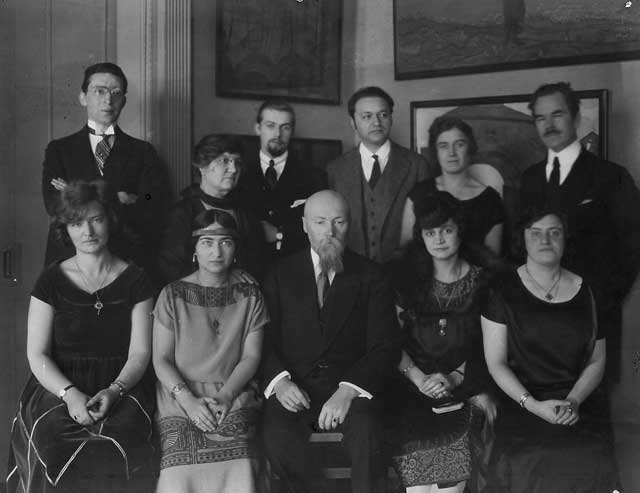
Photography
of 07.12.1924, sitting from left: Esther Lichtmann - Enta;
Sinaida Lichtmann (born
Shafran, married again Fosdick) - Radna; Nikolaus
Roerich - Fujama; Nettie Horch - Poruma;
Frances Grant - Modra; standing from left: Louis Horch - Logwan;
Sofie Shafran - Smotrjatschaja; Swetoslaw
Roerich - Ljumou; Maurice Lichtmann - Nuzija or Awirach; Tatjana Grebentschikowa
- Naru and Georgij Grebentschikow - Taruchan. Not
present: Helena Roerich - Urusvati und Jurij Roerich - Udraja.
Section V: The Law of the Disciple
At all times
spiritual discipline was part of the higher path: In the Buddha's school, among
the disciples of Jesus, the Pythagoreans, Essenes, and Sufis, and likewise in
the Middle Age orders of the Cistercians, of St. John, or the Knights Templar.
Discipline
is the beginning of everything. (Leaves of Morya's Garden II, 250 [253])
People
do not realize the foundation of the Teaching of Buddha. The foundation is
discipline. Spiritually and bodily the monk of the community was striving to
hold on to the path. In the first years he was under a heavy obedience. He was
forbidden to crucify himself with ascetic practices, but he was enjoined to
conduct the battle under the sole command of the spirit. Thus
austerely did Buddha instruct His disciples. Verily, they knew joy only in
spiritual battle; that is why the thorns of the path are spoken of.
Only
when the will of the spiritual warrior had become leonine, and the silver
bridle of the spirit gleamed upon the feelings of the disciple, only then did
the Master lift the veil slightly and assign a task. And then gradually the
disciple was initiated into the mysteries of knowledge. (Leaves of Morya's
Garden II, 251 [254])
The
path of the Teaching is the same now as it was then. For coming closer and for
the highest confidence, the very same foundations are necessary: reverence for
the Hierarchy and discipline of spirit. (Helena Roerich Letters Vol. I, letter
of 11.02.1929)
This discipline is
not an end in itself. It does not aim at enslaving you
either. Rather, it is a necessary means to achieve the highest goal: It is only
discipline that makes a spiritual life of your soul and an inner development
possible. Following the rule promotes the growth of the divine within us; every
offence stains and weakens it.
If
you want to reach the goal, you need to apply the necessary means.
Most candidates
fail already because of these external requirements.
1. Submission to the Law of the
Disciple
With your
acceptance as a disciple, even if it is for trial only, the law of the disciple
applies to you immediately.
If
a man is content to continue life on such terms as worldly conditions offer, he
is dependent upon worldly opinions, but if he continues in discipleship
he must be content to obey the laws of discipleship. (Teachings of the Temple
Vol. I, Lesson 115 “The Law of Primogeniture”)
The old casualness
is over. You are now part of a higher order than the ordinary man.
If
you are satisfied to evolve with the masses, well and good; if you would pass
beyond the masses, you must be subject to higher laws than those which govern
material substance. (Teachings of the Temple Vol I, Lesson 21 “Prayer”)
The law of the
disciple consists of age-old habits that were essentially the same in all
cultures and all religions.
There
are certain strict and inviolable rules for developing a disciple into an
Initiate, and each of these rules is simple in construction of form, and as old
as the stars and planets of the solar system. (Teachings of the Temple Vol. I,
Lesson 48 “The Path of Light”)
These collected
experiences transmitted from Above serve only one purpose: your sanctification!
The
rule of the first Christian order, the so-called "Rule of the Angel,"
was given to St. Pachomius by an angel with the words: "By following these
habits, all flesh will be saved."
Your
testing and examination in the next few years will essentially be about whether
you are capable of living according to this higher
law.
We
may yet walk along the arduous path together, as you, you alone, have to
weave your destiny. We may yet meet: but if at all, it
has to be along and on — those adamantine rocks with
which our occult rules surround us — never outside them. No, never can we
pursue our further journey — if hand in hand — along that highway, crowded
thoroughfare, which encircles them, and on which Spiritualists and mystics,
prophets and seers elbow each other nowadays. The motley crowd of candidates
may shout for the Sesam to open: it never will, so long as they keep outside
those rules. Those laws are the outcome of ages of wisdom. Nevertheless, were
one but to obediently follow them, they could be made to gradually yield to
one's desire and give to him all he asks of them. The passions, the affections
are not to be indulged in by him, who seeks to know; for they wear out the
earthly body with their own secret power. (Mahatma Letters, letter No. 48 of
03.03.1882)
A complete change
of your previous way of life is required if you want to go through the
education of the disciple of a great Master.
No
student of occult philosophy has ever succeeded in developing his psychic
powers without leading the life prescribed for such students. The rules laid
down by the ancient teachers of Occult Science are inflexible; and it is not
left to the discretion of any teacher either to enforce them or not to enforce
them according to the nature of the existing circumstances. If you find it impracticable
to change the present mode of your life, you cannot but wait for practical
instruction until you are in a position to make such sacrifices as Occult
Science demands; and for the present you must be satisfied with such
theoretical instruction as it may be possible to give you. (Mahatma Letters,
letter No. 131 of 26.06.1882)
The requirements
are so high also because the Mahatmas
must prevent the misuse of knowledge or of forces by unsuitable or even
malicious applicants.
The
Occult Science is not one, in which secrets can be communicated of a sudden, by
a written or even verbal communication. If so, all the "Brothers"
should have to do, would be to publish a Hand-Book of
the art which might be taught in schools as grammar is.
Till
the Neophyte attains to the condition necessary for that degree of Illumination
to which, and for which, he is entitled and fitted, most if not all of the Secrets are incommunicable. The receptivity must
be equal to the desire to instruct. The illumination must come from within.
Till
then, no hocus pocus of incantations, or mummery of appliances, no metaphysical
lectures or discussions, no self-imposed penance can give it. All these are but
means to an end, and all we can do is to direct the use of such means as have
been empirically found by the experience of ages to conduce to the required
object.
And
this was and has been no secret for thousands of years. Fasting, meditation,
chastity of thought, word, and deed; silence for certain periods of time to
enable nature herself to speak to him who comes to her for information;
government of the animal passions and impulses;
utter
unselfishness of intention, the use of certain incense and fumigations for
physiological purposes, have been published as the means since the days of
Plato and Iamblichus in the West, and since the far earlier times of our Indian
Rishis. (Mahatma Letters, letter No. 49 of 05.08.1881)
Today, as at all times, the highest path of a disciple of wisdom is
reserved to only a few.
Many
are called, but few are chosen. (Matthew 22, 14)
If
one were to expound the conditions and aims of Yoga, the number of applicants
would not be great. For them the renunciation of selfhood would be dreadful.
Such a way of life, with the assumption of all the burdens of surrounding
imperfections, will not be pleasant to many. (Hierarchy 451).
Enter
ye in at the strait gate: for wide is the gate, and broad is the way, that
leadeth to destruction, and many there be which go in thereat:
Because strait is the gate and narrow is the way, which leadeth unto life, and
few there be that find it. (Matthew 7, 13, 14)
Submission to the
law of the disciple is the first criterion for separating the wheat from the
chaff.
The
higher law, the sacred law, is not for many. (Infinity I, 83)
The
higher paths lead to the summit. The common highway does not lead to the Holy
Mountain. (Leaves of Morya's Garden I, 141 [158], 213 [239])
Real teachers
always make a strict selection and accept only a small number of disciples.
On
the spiritual level, quality matters more than quantity.
With a few
faithful followers the teacher achieves more than with many lukewarm ones.
If
you individually had held each incoming disciple to as strict account for the
breaking of the rules of discipleship as you are sometimes held by those who
imagine that you have broken your obligations in some respect, you might not
have had more than a dozen loyal disciples left today, but that dozen would be
so fitted by interior and exterior development as to have been able to hold any
position in the Temple work satisfactorily to us. (Teachings of the Temple Vol.
II, Lesson “Divine Indifference”)
2. Submission to the Rule of
the Ashram
When you are
accepted as a disciple, even if it is for trial only, you will be admitted at
the same time to the Ashram of your teacher. As a member of this community, you
must submit to the rule that governs here.
Every community
needs a firm, hierarchical order to which everyone has to
adapt. This is where most of the esoteric projects of our days fail.
Precisely
outlined are the statutes of the Community of Knowledge. (Agni Yoga 93)
Obviously, anyone
who is unable or unwilling to abide by the rule of the Ashram (not only in the
Ashram itself, but also during the time he is sent out into the world) cannot
permanently live in this community which has placed itself under this law.
Prove
your willingness to serve God by serving the God in each other. Prove your
ability for discipleship by obeying the laws of discipleship. (Teachings of the
Temple Vol. II, Lesson “Your Choice”)
"Culture
is the rule of a religious order" says Ludwig Wittgenstein.
He wants to say:
If a community wishes to build a higher culture – the New World –, it has to submit to higher laws than those that apply to the majority of the people continuing to live under the old
order.
Thus,
let us apply the higher laws to the earthly plan. (Hierarchy 291)
"Does
anything else apply when I have been a disciple for many incarnations already
than when I yet want to become a disciple?"
No. In both
instances, you have to live by the rule: In the one
case, in order to confirm your position as a disciple,
in the other case in order to reach it yet.
3. Purification
Tintoretto “Baptism of Christ”
A disciple on
probation arrives in the Ashram completely filthy. In a spiritual sense, he is actually stained by his previous worldly habits. His gross
radiations stink and pollute the pure air in this sacred place. Therefore, first of all, a thorough purification is required.
The
very first necessity for securing reliable and efficient instruction is such a
purification of mind and body as but few among the races of earth are willing
to submit to in this day and age. (Teachings of the
Temple Vol. I, Lesson 117 “The Circuit of the Soul”)
This cleansing is
being effected in a natural way by your participating
in the purer life in the Ashram. Just staying at a sacred place, living
together with spiritually superior beings, stepping regularly before the
teacher, and following the principles that apply here bring about a purification
– even though you do not do anything more than sharing the life of your family.
At all times the
secret of the monasteries was:
Living
in a holy place sanctifies. (Nicholas
Roerich "Star of the Morning")
You will learn
that by joining the community in spirit and living in an “Inner Temple”, the
“Ashram in the Heart”, you can achieve the same purification as if you were
physically visiting a sanctuary.
In the presence of
the teacher – regardless of whether it be physical or in spirit! – there can be
no gross, unworthy behaviour, no doubt and no depression. (See the Broadcasting
“Living in continuous Presence of the teacher”)
Can
I lie before the Master? Can I conceal anything from the Master? Can I
contemplate treason in the presence of the Master Himself? (Fiery World II,
118)
4. The 10 Pillars of the
Practice of Agni Yoga
"What
exactly do the law of the disciple and the rule of the
Ashram pronounce?"
Specifically, this
means: The 10 Pillars of the Practice of Agni Yoga from now on form the
spiritual framework within which your earthly life takes place. Let us briefly
review what the individual pillars mean precisely to a disciple:
*****
1st pillar: The
consciousness of the high dignity of being the disciple of a Master is the
basis of your existence. It is formed in the Ashram at the feet of the teacher.
You must preserve and defend it when descending down to
earthly life. You learn to appear on the material level with the attitude of a
spiritual disciple.
*****
2nd pillar: You
keep the rules as to the rhythm of the day automatically by your living in the
Ashram: You meet the teacher in the morning, at noon and in the evening. At
fixed times, you participate in meditation, study, education and service.
*****
3rd pillar: You
follow the rules regarding nutrition automatically as well: As
long as you are living here, you have no choice but to make do with the
kind and the (small) amount of food that are customary in a temple. Certain
things such as meat, alcohol, cigarettes or chocolate are simply not available
here.
*****
4th pillar: Most
people do not want to hear about obedience. Our Broadcastings on this topic
receive only little attention.
However, you have to show perfect obedience to your teacher. His effort
is in vain, and he will not keep you as a disciple, unless you do what he tells
you to do.
It makes no sense
for you either to apply for acceptance as a disciple if you are not willing to
follow the instructions of your teacher.
Obedience is the
key to the integration into the Cosmic Order, the basis of the succession after
a great spirit, and the first step towards a real cooperation with the Higher
Powers.
Finally, no
community, not even the Ashram of a teacher, can exist without that the hierarchical
principle takes effect.
*****
5th pillar: You
realize the ideal of living in two worlds easily when you first visit the
Ashram in spirit in the morning, then descend to the world during the day with
tasks and assignments and finally return to the sanctuary in the evening.
*****
6th. pillar: You
naturally practice selflessness through your living in the community. Your more
experienced classmates will see to it that your egotism is driven out!
In a temple, you
will have to give up most of the selfish pleasures of your old life. From now
on, your delights are meditation, spiritual ascent and service.
*****
7th pillar: The
higher connection, the conversation with your teacher becomes a self-evident
part of your new life: You meet him in the morning, at noon and in the evening.
Meditation,
especially in the evening, is indeed a touchstone for compliance with the other
habits: Violations of the rules regarding rhythm of the day or nutrition render
the higher communion impossible.
You will soon find
out yourself: If you take a meal in the evening, eat a lot and heavily, and
maybe even enjoy a glass of wine, you are of course not a bad man. A connection
with the higher world, a spiritual conversation with a non-incarnated teacher, however,
is not possible in this state!
Again, you must
plan the day by looking back from its end and avoid anything that impedes your
highest joy, the dialogue with your father in the evening.
*****
8th, 9th and 10th
pillar: Service and education are the essential components of your new life as
a disciple. Every day, you receive an assignment for selfless service to the
common good and a task for your personal spiritual ascent.
*****
Of course, you have to adhere to these rules not only in the Ashram, but
also when you are staying on the material plane. You see, entering the Ashram
of your teacher completely changes your life.
5. No Compulsion
Duccio di Buoninsegna “Maestà - The twelve-year-old Jesus in the Temple”
"Discipline,
law of the disciple, rule of the Ashram: That sounds a bit like constriction
and oppression to me."
That is completely
wrong! You must not under any circumstances perceive the subjection to
spiritual discipline as compulsion! Then, entering the Ashram would be
worthless. If you experience the customs of the higher culture that prevails
here as a burden, you do not belong here by your very nature.
*****
You are living in
the house of your father, your true, spiritual, eternal "Father in
Heaven." Like the twelve-year-old Jesus in the temple you should say:
Was
it not clear to you that my right place was in my Father's
house? (Luke 2, 49)
There, where your
beloved father dwells, you want to live, too. It is your highest bliss to be
close to him and to share in the sanctity of his abode – which is created
precisely by the rule! If it does not fill you with joy and enthusiasm to live
here, you are out of place here, then your heaven is somewhere else.
*****
Finally, it is
impossible to walk the Higher Path otherwise than with joy!
One
does not go far by growling. (Fiery World I, 524)
Austere
is the path of approach to Brotherhood. Earthly joys leave us. But much higher
and deeper joys come to take their place; however one
must learn to grow up to them, to the joy of the nearness of the White
Brotherhood, the joy of the possibility of cooperation with Them, the joy of
constant broadening and deepening of the understanding of life and active
cosmic laws. Likewise there is no small joy from
contacts with the harmonious hearts of the closest friends and co-workers.
(Helena Roerich Letters Vol. II, letter of 19.07.1937)
6. A Week with Helena Roerich
in the Kulu Valley
"This
is still very abstract and quite far removed from my everyday life. Could you
not give us a practical example from today’s time?"
Let
us take a look at Helena Roerich. She spent the last
approximately 20 years of her life away from the world in the Himalayas, in the
Kulu Valley near the Mahatmas.
From
there she guided the co-workers and Agni Yoga groups in America and Europe by
letter. Even the receipt of such a letter from her hand was a privilege to be
envied.
Even
greater was the honour to visit Helena Roerich for a few weeks or even months
in the Kulu Valley. It was only granted to the very few who were ready for it.
Again, there were some little jealousies: Who is closest to her? Who is allowed
to see her when, how often and how long? Why is he allowed to go, but not me?
*****
Now
imagine: You are invited to spend some time with this great teacher. Will not
these be the most beautiful and most important days of your life?
You
will quite naturally and as a matter of course adapt to the customs of this
place: You will get up early in the morning together with Helena Roerich, do
some physical exercises with her, invoke the Brotherhood, meditate and read the
Teaching.
You
will quite naturally and as a matter of course imitate her outward life in all
its details, for example as far as food and the rhythm of the day are
concerned. This is brought about necessarily alone by living together with her.
*****
You
will be proud and happy to be able to participate in her Great Work, to take
upon you some of her tasks, and to be entrusted with certain assignments, for
example writing letters or making translations.
You
will actually be eager to receive instructions on how
to perfect yourself and about the next steps on your personal spiritual path.
In her presence, under her supervision (which comes naturally from living
together) you will diligently practice the exercises she imposes on you –
because you feel how you are growing thereby a little bit every day.
*****
Rough,
unworthy behaviour (irritability, negligence, impurity, anger, insults, roaring
or even aggressiveness) prohibit themselves in her presence. Thus, you are
raised solely by being allowed to live together with her in the sublime
atmosphere of her world where certain things are simply inadmissible. (Svetoslav Roerich
"Helena Roerich")
In
the Kulu Valley, this sacred place, there are no tobacco, alcohol, meat or
chocolate, no restaurants, easy-going girls and no football matches.
Thus,
if you have not given up the desire for these or similar pleasures yet, you
will have to leave her abode (actually, because you will be ashamed, secretly
through the back door!) and walk a few miles to the next village. You then have to flee the sanctuary and give up the proximity to the
teacher.
But
do you really think you could approach Helena Roerich on your return, smelling
of beer or cigarettes, with an aura saturated with worldly desires? That is
simply unthinkable!
If
you have retained at least a spark of sensitivity, you will not dare to pollute
her and her abode in this way. And she would not allow that either – though not
in order to discipline or to punish you, but to
protect herself and the holy place!
By
accepting a disciple, the Teacher includes him in his consciousness and
establishes with him an invisible but active bond. From that very moment, the
Teacher knows at any instant what is happening to his disciple. He can even
know his fleeting thoughts, and can direct him
accordingly. Therefore, it must be understood how hard, how unbearable for the
High Consciousness of the Teacher would be any disharmonious vibrations caused
by unpurified thoughts of the disciple, how inadmissible under such a close,
sacred bond with the Teacher would be any still-not-outlived lust. Every
disharmonious vibration cuts into the current of this
bond, and if repeated can break it altogether. (Helena Roerich Letters Vol. I,
letter of 29.08.1934) (Svetoslav Roerich “Helena
Roerich”)
You
see: There is no compulsion! Rather, living together with a high spirit by its
very nature gives rise to certain unalterable necessities.
If
you wish to stay in this heaven, you cannot help but abstain from everything
that renders impossible the community with the high beings living here.
Nobody
is disciplining you! Nobody punishes you! You yourself destroy your own
happiness should you be so much a slave to your desires that they force you to
leave your heaven!
"Now
I understand the concept of entering the Ashram of the teacher in spirit: I
live the way I would live if in actual fact I would dwell in community with my
teacher. His physical presence is not required for that. "
At the latest
after death, you will really be able to live together with Helena Roerich or another great teacher in his Ashram in the Subtle
World. But only if you prepare during your current earthly life for this lofty
goal in such a way that you are in fact mature enough to be admitted.
Undoubtedly, the best preparation is to practice already on earth to live in
this heaven.
How this can be
achieved we shall discuss in the Broadcasting "Living in the Ashram of the
Teacher".